






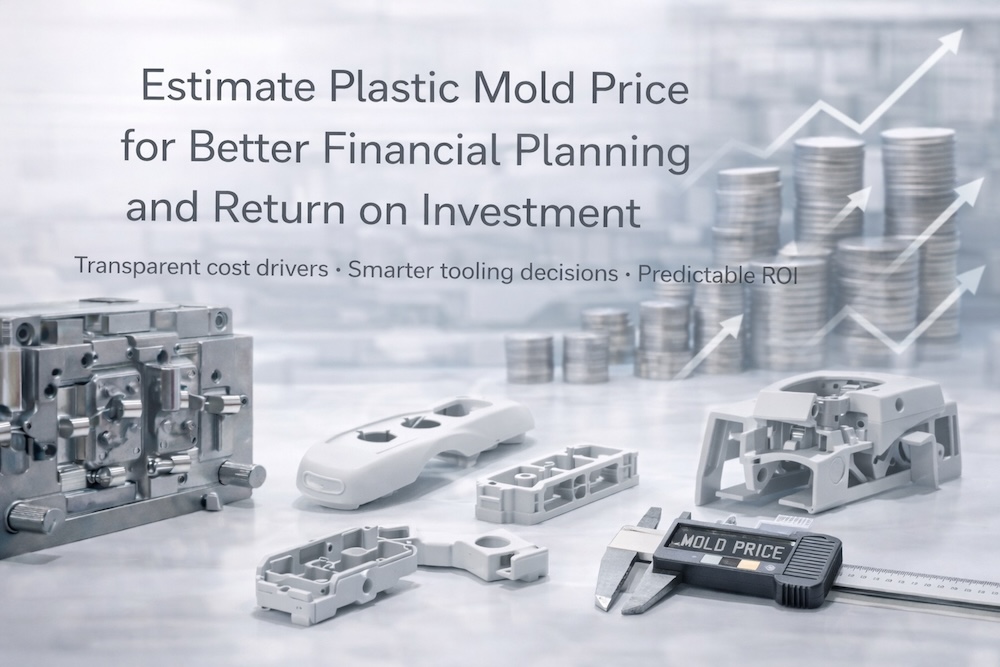
Estimate Plastic Mold Price for Better Financial Planning and Return on Investment
Estimate Plastic Mold Price for Better Financial Planning and Return on Investment
Estimate Plastic Mold Price for Better Financial Planning and Return on Investment
Transparent cost drivers • Smarter tooling decisions • Predictable ROI
For most injection molding projects, the plastic mold is the single largest upfront investment. If the mold price is underestimated—or optimized for the wrong goal—it can quietly erode margins, delay launches, and limit future scalability. That is why learning how to estimate plastic mold price accurately is essential for sound financial planning and a strong return on investment (ROI).
This guide explains what really drives mold pricing, how to align tooling cost with production strategy, and how TaiwanMoldMaker.com helps customers turn tooling spend into a long-term asset rather than a sunk cost.
Why plastic mold price matters to ROI
A mold is not just a cost—it is a production engine. The right mold:
-
Lowers unit cost over its lifetime
-
Supports stable quality and predictable output
-
Enables automation and future scale-up
-
Reduces downtime, rework, and emergency repairs
The wrong mold—cheap or over-engineered—can do the opposite. Accurate price estimation lets you model ROI before steel is cut, not after problems appear.
Core factors that determine plastic mold price
Plastic mold pricing is driven by a combination of technical complexity and business strategy. The main factors include:
1. Part design and geometry
-
Overall size and projected area
-
Wall thickness uniformity and rib complexity
-
Tolerance requirements and cosmetic expectations
-
Undercuts, slides, lifters, and side actions
Complex geometries increase design time, machining hours, and assembly effort during Injection Mold development.
2. Mold type and cavitation
-
Single-cavity molds
-
Lower upfront cost
-
Higher unit cost at scale
-
-
Multi-cavity molds
-
Higher tooling investment
-
Lower cost per part and faster ROI at volume
-
Choosing cavitation is a financial decision as much as a technical one.
3. Tooling material and construction
-
Soft tooling (aluminum or hybrid)
-
Lower price, faster build
-
Ideal for validation, pilot runs, or uncertain demand
-
-
Pre-hardened steel molds
-
Balanced cost and durability
-
Common for stable mid-volume programs
-
-
Fully hardened production steel molds
-
Highest upfront cost
-
Lowest total cost of ownership for high-volume, long-life products
-
These options are typically evaluated during Mold Service and early DFM reviews.
4. Runner system and automation level
-
Cold runner
-
Lower mold price
-
Higher material waste and longer cycles
-
-
Hot runner / valve gate systems
-
Higher mold cost
-
Lower scrap, better cosmetics, faster cycles
-
-
Automation readiness
-
Robot take-out, sensors, and vision systems add cost
-
But reduce labor and quality risk in production
-
A higher initial mold price often delivers a faster payback period.
5. Validation and documentation requirements
For regulated or high-reliability products, pricing must include:
-
DFM and flow/cooling analysis
-
T0/T1 trials and corrective loops
-
First Article Inspection (FAI) and CMM reports
-
IQ/OQ/PQ or PPAP (if required)
These activities are essential to protect downstream ROI and are coordinated through Molding and quality teams.
Typical plastic mold price ranges (indicative)
While every project is unique, rough benchmarks help early budgeting:
-
Simple single-cavity soft mold: entry-level investment for pilot runs
-
Single-cavity production steel mold: moderate investment for stable demand
-
Multi-cavity production mold: higher investment justified by high volumes
-
Complex molds (slides, hot runner, gas assist, etc.): premium pricing tied to performance gains
Exact pricing depends on part size, resin, cavitation, and quality expectations—this is why early DFM is critical.
How to estimate ROI from a plastic mold
To evaluate return on investment, consider:
-
Tooling cost
One-time investment amortized over tool life. -
Unit cost reduction
Savings from shorter cycle time, reduced scrap, and higher cavitation. -
Volume forecast
Annual production × expected tool life. -
Risk reduction
Fewer defects, less downtime, and smoother audits.
A higher mold price can still be the most profitable option if it reduces unit cost and operational risk over time.
Cost-optimization strategies without sacrificing quality
At TaiwanMoldMaker.com, we help customers control mold price while protecting ROI by:
-
Starting with lower cavitation and planning copy-cavity expansion
-
Using hybrid tooling (steel only where wear or polish demands it)
-
Standardizing mold bases and components
-
Designing tools that are automation-ready, even if automation is phased in later
These strategies are typically defined during Custom Mold & Design Maker reviews.
RFQ checklist for accurate mold price estimation
To receive a realistic and comparable mold quotation, prepare:
-
3D CAD (STEP/IGES) + 2D drawings with CTQs
-
Target annual volume and expected product life
-
Preferred materials and alternates
-
Cosmetic and tolerance requirements
-
Planned production site and machine tonnage
-
Validation and documentation expectations
-
Budget priorities (lowest upfront vs. lowest total cost)
Submit your details here:
Contact
Why estimate mold price with TaiwanMoldMaker.com
-
Engineering-led DFM to eliminate hidden cost drivers
-
Transparent breakdown of tooling options and trade-offs
-
Clear linkage between mold price, unit cost, and ROI
-
Scalable tooling strategies from pilot to mass production
-
Proven results across multiple industries—see Customer Examples
If you want to estimate plastic mold price accurately for better financial planning and ROI, TaiwanMoldMaker.com provides the technical insight and commercial clarity needed to make confident tooling decisions.
Start here:
Custom Mold & Design Maker →
Mold Service →
Injection Mold →
Molding →
Contact
