






Custom Optical Connector Components Manufacturing for Datacom and Active Optics Applications
Custom Optical Connector Components Manufacturing for Datacom and Active Optics Applications
Custom Optical Connector Components Manufacturing for Datacom and Active Optics Applications
As datacenter networks, active optical systems, industrial platforms, and high-speed interconnect architectures continue to evolve, buyers are under growing pressure to source smaller, lighter, and more precise connector-related components. In this environment, custom manufacturing is no longer only about making a plastic part. It is about delivering a complete component solution that fits electrical performance goals, assembly requirements, environmental demands, and production timelines.
For OEMs, module developers, and connector suppliers serving datacom and active optics applications, the most reliable sourcing strategy is to work with a manufacturing partner that can support multiple component categories under one roof. That may include precision plastic parts, silicone sealing elements, and stamped metal components used in the same product family. INTERTECH supports this type of workflow through its custom mold and design service, mold service, injection mold solutions, silicone mold capabilities, liquid silicone rubber mold services, metal stamping solutions, and molding service.
Why Optical Connector Components Require Specialized Manufacturing
Optical connector components are often small in size, but they play an outsized role in product performance and assembly stability. In datacom and active optics applications, even non-electrical parts can affect product reliability, contamination control, assembly speed, and long-term field performance.
Buyers in this segment are typically not looking for a general commodity supplier. They need a manufacturer that understands tight tolerances, repeatable molding conditions, material compatibility, and the integration of plastic, silicone, and metal elements into one finished assembly strategy.
This is especially important when components must work together in compact architectures such as on-board optical systems, rugged transceiver platforms, high-density connector assemblies, or active cable-related applications. That is why working with an experienced custom mold manufacturer can help reduce development risks before mass production begins.
Common Custom Components for Datacom and Active Optics Projects
A typical optical interconnect project may involve far more than one molded housing. Depending on the product architecture, buyers may need a mix of structural, protective, sealing, and shielding parts.
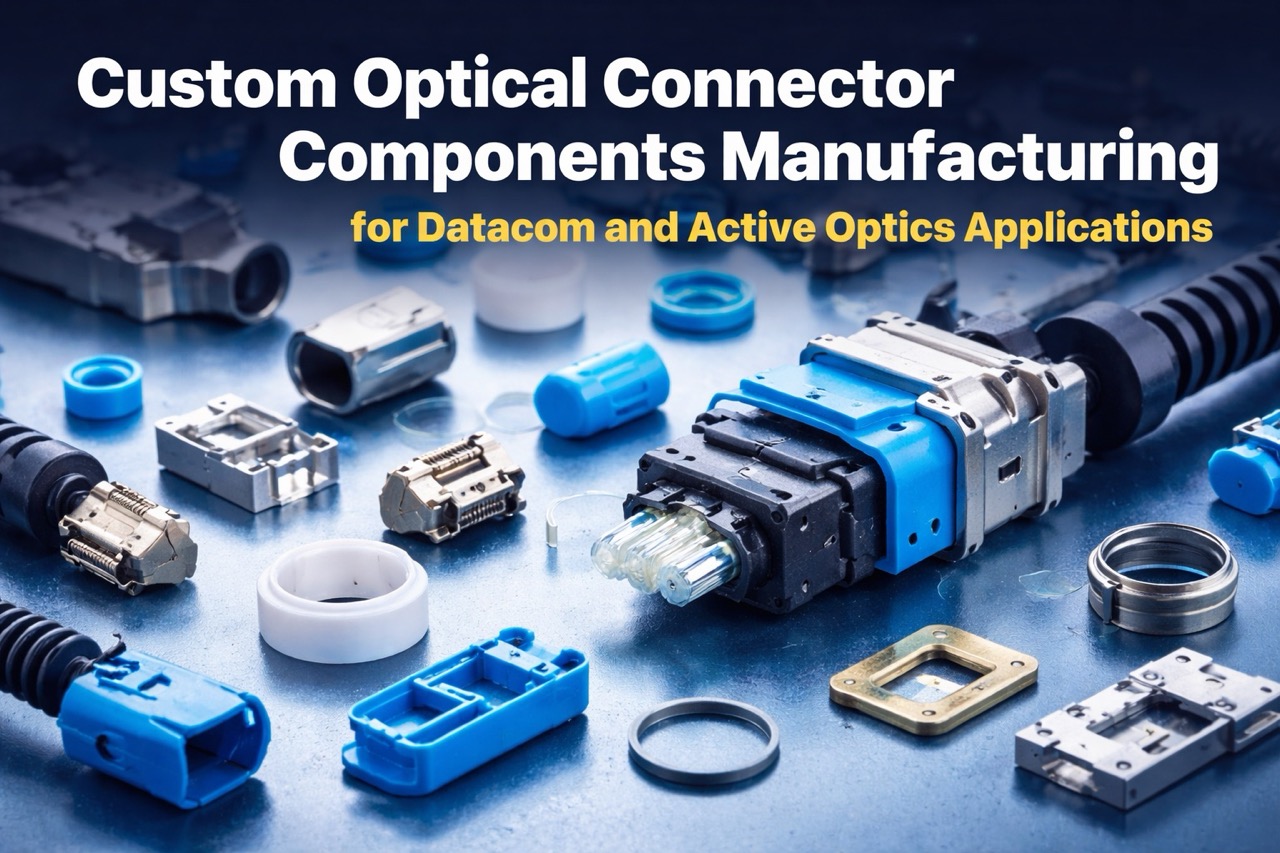
Examples of custom optical connector components include:
- ferrule fixation parts
- metal ferrule clamps
- MT ferrule retention parts
- dust caps and dust cover caps
- transport caps for protection during shipping and assembly
- EMI shielding plates
- EMI shielding springs
- sealing rings
- air sealing parts
- silicone protective covers
These parts may appear simple when viewed individually, but in actual production they often require different tooling methods, different materials, and different process controls. A supplier that can coordinate these manufacturing streams more efficiently can reduce lead time, simplify vendor management, and improve consistency across the full component set.
When buyers need multiple part categories in one project, choosing a partner that offers both plastic molding services and precision metal stamping can create a significant sourcing advantage.
Precision Plastic Injection Molding for Connector and Protective Parts
Many optical connector-related components are best produced through precision injection molding. This is often the preferred route for protective caps, transport caps, alignment-support parts, and other custom plastic geometries that require stable dimensions and repeatable mass production.
A well-planned injection molding program starts with design review and tooling strategy. That is why early-stage engineering support matters. With INTERTECH’s custom mold and design service and professional mold service, buyers can move from concept review to tooling evaluation with a clearer understanding of manufacturability, parting line strategy, draft, shrinkage, and expected production efficiency.
For production-stage programs, the company’s injection mold capability and plastic molding service support the transition from tool build to stable part manufacturing. This is valuable for buyers who need repeatable plastic components for ongoing connector or active optics production.
Silicone and LSR Components for Sealing and Protection
In active optics and high-speed connector applications, sealing components are just as important as structural ones. Silicone parts are commonly considered when buyers need flexibility, environmental resistance, cushioning, or contamination protection.
This makes silicone a practical option for parts such as sealing rings, air sealing structures, protective covers, and some types of dust-prevention accessories. Buyers looking for these types of components often benefit from working with a supplier that offers both silicone mold development and liquid silicone rubber mold manufacturing.
For soft sealing applications and custom elastomer parts, INTERTECH also provides silicone mold solutions that can support custom product development from prototype to production. This is especially useful for projects requiring sealing rings, air sealing parts, or flexible protective components that must match compact optical assemblies.
Metal Stamping for EMI Shielding and Retention Parts
Plastic and silicone components alone are often not enough. Many optical connector assemblies also depend on thin metal parts for shielding, retention, spring action, or grounding-related mechanical functions.
That is where stamped metal parts come in. EMI shielding plates, shielding springs, ferrule clamps, and related retention parts may require high-precision stamping, bending, forming, and post-processing. INTERTECH’s metal stamping service is well suited for small functional metal parts used in connector-related projects.
For buyers, this matters because sourcing metal and molded parts from separate vendors can slow development and create tolerance-matching issues during assembly. By combining metal stamping manufacturing with molding services, a supplier can improve coordination during both validation and volume production.
What Buyers Should Look for in a Manufacturing Partner
When sourcing custom optical connector components, buyers should evaluate more than unit price. A better checklist includes:
- Can the supplier support both tooling and volume production?
- Can it handle different part families, including plastic, silicone, and metal?
- Does it provide DFM feedback before tooling release?
- Can it help optimize part geometry for stable molding or stamping?
- Is it prepared to support pilot runs as well as repeat production?
A supplier with broader process coverage is often better positioned to support product families that evolve over time. Datacom and active optics projects frequently move through design changes, packaging updates, material revisions, or assembly refinements. A manufacturer that can respond across multiple component types becomes more valuable over the life of the program.
This is why many buyers prefer a partner offering custom mold development, injection molding support, silicone part tooling, and metal part production in a more integrated manufacturing model.
A One-Stop Manufacturing Approach for Optical Connector Components
For buyers developing products in active optics, datacom interconnects, or related high-speed communication systems, a one-stop manufacturing approach can simplify the sourcing process. Instead of managing separate vendors for molded caps, silicone seals, and stamped shielding parts, procurement teams can work with a single manufacturing partner that understands how these components interact in the final application.
INTERTECH’s published service structure supports this approach by covering mold development, molding production, silicone processing support, liquid silicone rubber tooling, and metal stamping manufacturing. For buyers seeking custom component manufacturing in Taiwan, that combination is particularly useful for programs that require both precision and sourcing flexibility.
Conclusion
Custom optical connector components manufacturing is becoming increasingly important for datacom and active optics applications. As products become more compact, more specialized, and more performance-driven, the supporting parts around the optical path become more critical as well.
From molded protective caps and ferrule-related plastic parts to silicone sealing elements and stamped EMI shielding components, buyers need manufacturing partners that can deliver consistency across multiple processes. INTERTECH is positioned to support that need through integrated capabilities in custom mold design, plastic molding, silicone mold manufacturing, LSR mold solutions, and metal stamping service.
For teams planning a new connector-related project or looking to localize supply with a Taiwan-based manufacturing partner, the next step is to review part drawings, material requirements, and expected quantities early. That makes it easier to build the right tooling strategy and shorten the path to production.
If you are looking for a trusted Taiwan supplier for custom optical connector components, sealing parts, and shielding components, please contact INTERTECH to discuss your project requirements.
