






Maintain Strict Standards in Medical Device Plastic Injection Molding for Sensitive Components
Maintain Strict Standards in Medical Device Plastic Injection Molding for Sensitive Components
Maintain Strict Standards in Medical Device Plastic Injection Molding for Sensitive Components
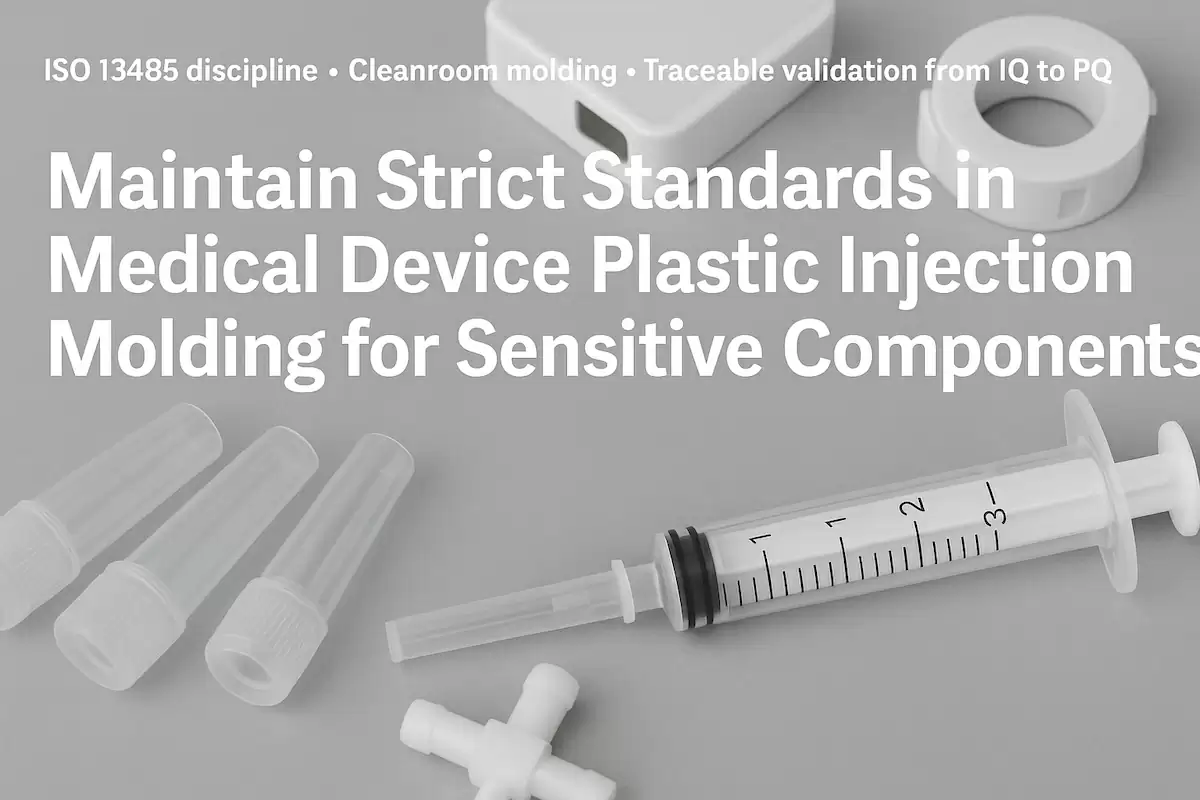
ISO 13485 discipline • Cleanroom molding • Traceable validation from IQ to PQ
When lives and clinical outcomes depend on your product, “good plastic parts” are not enough. Sensitive components for diagnostic devices, drug-delivery systems, monitoring equipment, and labware require strict standards in medical device plastic injection molding—from material selection and tooling all the way through validation and packaging.
Use this guide—and the TaiwanMoldMaker.com network—to maintain those standards consistently and move sensitive components from RFQ to commercial supply with confidence.
Explore our end-to-end services:
Custom Mold & Design Maker → Mold Service → Injection Mold → Molding → Customer Examples → Contact
1. Quality systems that support sensitive components
For medical and life-science programs, the molding partner’s quality system is as important as its machines.
Key elements we emphasize:
-
ISO 13485-aligned QMS
Document control, change control, CAPA, internal audit, training matrices, and management review. -
Risk management per ISO 14971
Product and process FMEAs tied directly to CTQs (critical-to-quality features) and control plans. -
Design & document traceability
DMR/DHR structure, revision-controlled drawings and CAD, and controlled access to electronic records. -
Supplier management
Approved material vendors, monitored performance, and documented incoming inspection criteria.
These foundations ensure that every engineering decision can be traced, justified, and reproduced when regulators or customers ask “why.”
2. Cleanroom molding and handling
Sensitive components—fluidic devices, implant-adjacent parts, components that contact drugs or diagnostics—often require controlled environments.
We design cells around:
-
ISO 14644 cleanrooms (typically Class 7/8) with HEPA filtration, differential pressure, and monitored particles.
-
Gowning procedures (garments, gloves, masks, hair covers) and personnel training.
-
Material hygiene: sealed conveying, dedicated dryers, validated purging, and lot segregation.
-
Robot take-out and closed transfer from mold to trays or nests to minimize human contact and fibers.
Where required, we integrate clean packaging cells for pouching, bagging, or tray loading under controlled conditions.
3. Material and sterilization strategies
For medical device plastic injection molding, resin choice is about much more than color and price.
We help you align:
-
Biocompatibility – ISO 10993, USP Class VI, or drug-contact requirements.
-
Sterilization method – EtO, gamma, e-beam, or steam (autoclave); plus expected cycle counts.
-
Extractables & leachables – especially for drug-device combinations and fluid paths.
-
Mechanical & environmental demands – impact, fatigue, creep, chemical exposure, and temperature.
Typical families include PP, PE, PC, COC/COP, PPSU/PSU, PEI (Ultem™), POM, PA, and medical-grade TPE/TPU—each with grade-specific approvals and processing windows.
4. Tooling and DFM standards for medical quality
Strict standards start at the tool design table.
Our DFM and tooling practices for sensitive components include:
-
48-Hour DFM Pack
Flow / cool / warp simulation, gate and vent plan, cooling layout, cycle model, and risk log. -
Steel and surface strategy
Corrosion-resistant steels (S136, 420SS, H13) with controlled hardness; polish and texture tied to cleaning and sterilization needs. -
Geometry & draft discipline
Uniform walls, radiused corners, and adequate draft to protect surfaces and avoid stress concentrations. -
Ejector and parting-line control
No ejector marks or flash in fluid paths, sealing regions, or critical optical zones. -
Maintainability
Standardized hardware, doweled inserts at high-wear features, and documented torque and cooling maps to keep tools consistent over their lifetime.
5. Scientific molding and process validation
For sensitive medical components, parameters must be defined by data, not by feel.
We implement:
-
Scientific molding techniques
-
V/P transfer by pressure, not position
-
Cavity-pressure sensors and gate-freeze studies
-
Weight ladders to set pack/hold correctly
-
-
Structured validation: IQ / OQ / PQ
-
IQ: Equipment installation, utilities, software, sensors, and calibration verified.
-
OQ: DOE-based parameter studies to establish the acceptable process window and define alarms/lockouts.
-
PQ: Production-rate runs at nominal settings to prove capability and stability over time.
-
-
Capability targets
CpK thresholds on CTQs (commonly ≥1.33 or per your specification), supported by FAIR and CMM/scan data.
The result is a golden recipe locked in the press and mirrored in MES, so every run returns to the same validated window.
6. Metrology, documentation, and traceability
Sensitive components require hard evidence that every lot meets spec.
We deliver:
-
Metrology packages
FAIR, CMM/optical scans, gage R&R, and where relevant, surface and color metrics (ΔE, gloss, haze, transmission). -
Functional and cleanliness testing
Leak, burst, occlusion, flow, or torque tests; bioburden or particle testing when required by the control plan. -
MES dashboards
OEE, CpK, scrap, kWh/kg, and lot genealogy—accessible via shareable reports or live views for remote audits. -
Device history records
Lot-level traceability linking material batches, tooling, machine, operators, and parameter ranges to each shipment.
7. Packaging and logistics for medical programs
For sensitive parts, the way they leave the plant matters as much as how they are molded.
We work with you to define:
-
Clean packaging formats – pouches, bags, thermoformed trays, or custom nests.
-
Labeling and UDI requirements – barcodes, QR codes, data matrix, and version control.
-
Sterile barrier validation support – coordination with packaging and sterilization partners (ISO 11607).
-
Shipping standards – shock/temperature constraints, palletization patterns, and regional storage conditions.
8. RFQ checklist (copy/paste)
To maintain strict standards from the start, include these items in your RFQ:
-
Regulatory pathway & device classification (FDA, EU MDR, other).
-
Target T1, validation (IQ/OQ/PQ), and SOP dates.
-
3D CAD (STEP/IGES) + 2D drawings with CTQs and GD&T clearly marked.
-
Intended sterilization method, number of cycles, and any shelf-life expectations.
-
Preferred materials and alternates, including required approvals (ISO 10993, food/drug contact, etc.).
-
Required cleanroom level (molding, assembly, packaging) and any cleanliness/bioburden tests.
-
Validation scope and capability targets (CpK, sample sizes, documentation format).
-
Packaging, labeling, and logistics needs (clean bags, UDI, pallet specs, Incoterms).
Send your package here → Contact
Why work with TaiwanMoldMaker.com for medical molding?
-
Strict, documented standards for medical device plastic injection molding focused on sensitive components.
-
Cleanroom, scientific molding, and validation capability integrated into a single program team.
-
Audit-ready documentation and MES visibility to support regulators, notified bodies, and OEM stakeholders.
-
A bridge-to-scale pathway: from pilot tools to multi-cavity production and multi-plant supply once your device gains traction.
Start here:
Injection Mold → Molding → Mold Service → Customer Examples → Contact
