






Refine Injection Mold Fabrication Processes to Decrease Errors and Reduce Rework
Refine Injection Mold Fabrication Processes to Decrease Errors and Reduce Rework
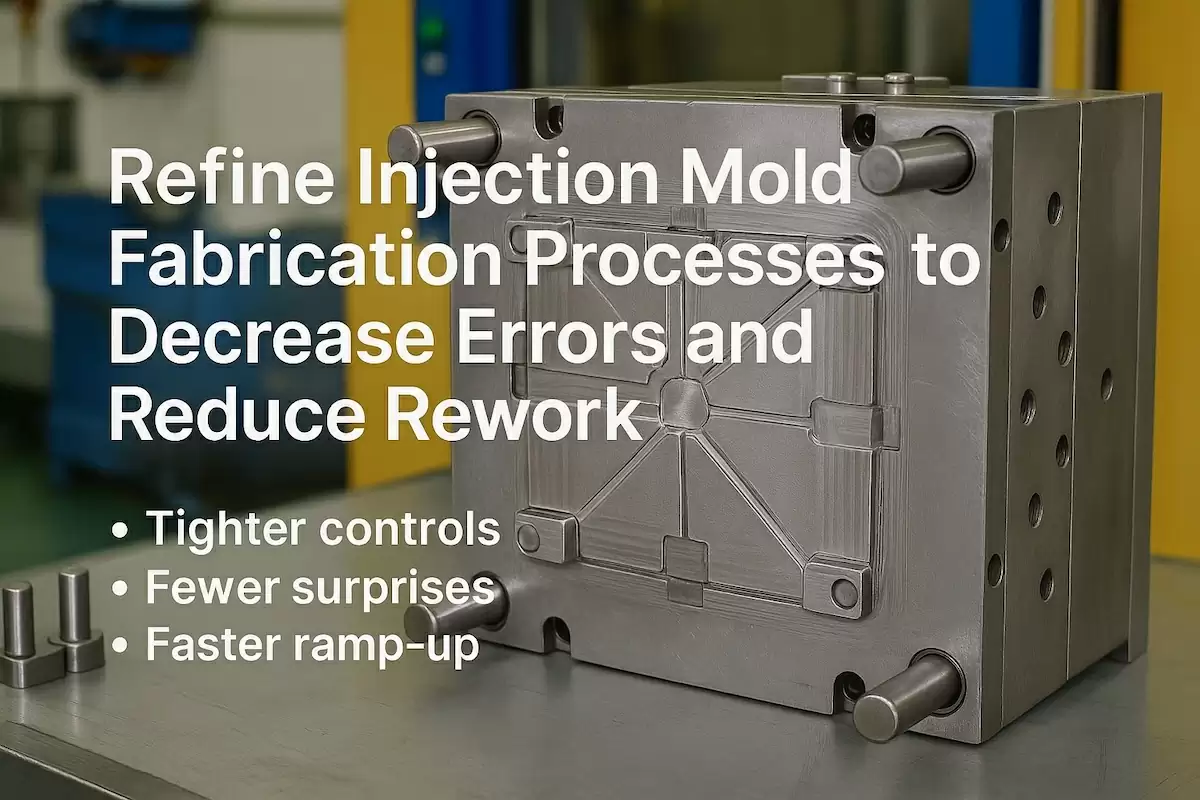
Refine Injection Mold Fabrication Processes to Decrease Errors and Reduce Rework
Tighter controls • Fewer surprises • Faster ramp-up
Every dimensional miss, weld-line problem, or galling issue in production usually starts much earlier—during mold design and fabrication. By refining how your tools are specified, built, and validated, you can decrease errors and reduce rework, instead of debugging problems on the press.
With the TaiwanMoldMaker.com network, you get standardized mold-making workflows, in-process quality gates, and audit-ready documentation from DFM to SOP.
Explore our end-to-end services:
Custom Mold & Design Maker → Mold Service → Injection Mold → Molding → Customer Examples → Contact
Where errors in mold fabrication really come from
Most “tooling problems” in production are symptoms of earlier gaps:
-
Vague or missing CTQs on 2D drawings.
-
No DFM / simulation for gating, cooling, and warpage.
-
Tolerance stack-ups not tied to true datums.
-
Non-standard components that complicate assembly and maintenance.
-
Lack of in-process checks during machining, EDM, and fitting.
-
Poor documentation of changes, welds, and bench work.
Our goal is to build right-first-time tools by making each of these steps visible, measurable, and repeatable.
Front-load quality with DFM and design standards
Before a chip is cut, we issue a 48-Hour DFM & Risk Pack:
-
Flow / Cool / Warp simulation with gate and vent recommendations.
-
Cooling layout including baffles, bubblers, and conformal-cooling candidates.
-
Parting-line & lifter/slide strategy to protect cosmetics and CTQs.
-
Steel and hardness plan for cores, cavities, and wear inserts.
-
Risk register listing potential flash, warp, burn, or galling issues and mitigations.
We also apply standard design rules:
-
Uniform walls where possible; ribs rather than heavy sections.
-
Draft and radii to support ejection and avoid stress risers.
-
Standardized ejector, leader-pin, and guide-bushing sizes.
-
Preferred hot-runner and component libraries to reduce “specials.”
Result: machinists and EDM operators work from clean, unambiguous 3D & 2D data.
Standardized mold fabrication workflow
To refine the process and prevent rework, each tool follows a controlled route:
-
Steel certification & prep
-
Verify steel grades and hardness against the plan.
-
Record heat numbers and traceability.
-
-
Rough machining & semi-finishing
-
CAM programs are simulated for gouge/overcut.
-
Critical faces are probed and logged before moving to finishing.
-
-
EDM & micro-features
-
Electrode libraries and wear logs to keep geometry consistent.
-
Controlled overburn values, especially for shut-offs and sealing faces.
-
-
Finishing & polishing
-
Defined steps for each polish grade (e.g., up to SPI A1 for optics).
-
Protect finished surfaces with fixtures and covers between operations.
-
-
Assembly & spotting
-
Blue-check spotting on shut-offs and parting lines.
-
Verified alignment of slides, lifters, and core-pulls before full clamp-up.
-
Each station signs off on a digital traveler so you know who did what, when, and with which parameters.
Metrology and tryout: catching issues before they reach your press
We combine tooling checks with molding trials to shorten debug loops:
-
Pre-assembly dimensional checks on critical cores, cavities, and inserts (CMM/optical).
-
T0 trial focused on:
-
Short shots for flow pattern confirmation.
-
Gate-freeze, cavity balance, and initial part weights.
-
Early identification of vents, welds, and hotspots.
-
-
T1 trial focused on:
-
CTQ dimensions with CMM/scan.
-
Cosmetic and flash assessment against a signed-off map.
-
Verification of ejection and cycle-time targets.
-
All adjustments—welds, spotting changes, venting, and polish corrections—are logged in a Tool Change Report, reducing surprises later in life.
Process controls that keep molds consistent
Refined mold fabrication is also about how tools are managed after handover:
-
PM templates with shot-based intervals, including cleaning, lubrication, and torque checks.
-
Spare parts kits (springs, pins, hot-runner heaters/TCs, seals) shipped with each tool.
-
Acceptance criteria for mold-transfer between plants (Taiwan ↔ SE Asia), so the tool behaves the same way everywhere.
-
MES integration at the press: linking each tool to recipe, OEE, CpK, and scrap trends.
This ensures the mold you accepted at T1 is the same mold you see in production six months later.
Example timeline with quality gates
-
Day 0–2: 48-Hour DFM & Risk Pack → review & approval.
-
Day 3–7: Steel prep, roughing, semi-finish machining; first tooling metrology check.
-
Day 8–14: EDM, finishing, polishing; assembly & spotting; hot-runner setup.
-
Day 15–17: T0 trial in production resin; gate-freeze, balance, first metrology.
-
Day 18–21: Corrections and fine-tuning (vents, polish, spotting).
-
Day 22–24: T1 trial; FAIR + CMM/scan; cosmetic map sign-off; Tooling Dossier delivered.
-
Day 25+: Optional PPAP or IQ/OQ/PQ; copy-cavity plan for ramp.
Timings depend on tool size, complexity, finish level, and validation scope, but the control points remain the same.
RFQ checklist (copy/paste—this is what helps us cut rework)
-
Target T1 and SOP dates with must-hit milestones.
-
3D CAD (STEP/IGES) + 2D drawings with CTQs and GD&T clearly marked.
-
Cosmetic map (viewing zones, texture codes, allowable knit/flow areas).
-
Material(s) & alternates, including UL/FR/UV/food/medical requirements.
-
Expected annual volume and cavitation strategy (pilot vs. multi-cavity/family).
-
Preferred standards (DME/HASCO, hot-runner brand, component libraries).
-
Required documentation (FAIR, CMM/scan, steel certs, Tooling Dossier, CpK targets).
-
Packaging & logistics (tool shipping, storage location, Incoterms).
Send your package here → Contact
Why work with the TaiwanMoldMaker.com network
-
Refined, documented mold fabrication processes that cut errors before they reach the press.
-
Simulation-led DFM plus standardized tooling libraries to keep designs lean and maintainable.
-
Metrology and trial discipline that reduces debug time and rework.
-
Audit-ready data from Tooling Dossiers to MES dashboards so stakeholders can approve fast.
Start here:
Custom Mold & Design Maker → Mold Service → Injection Mold → Molding → Customer Examples → Contact
