






Explore HDPE Plastic Injection Molding for Reliable Containers and Household Products
Explore HDPE Plastic Injection Molding for Reliable Containers and Household Products
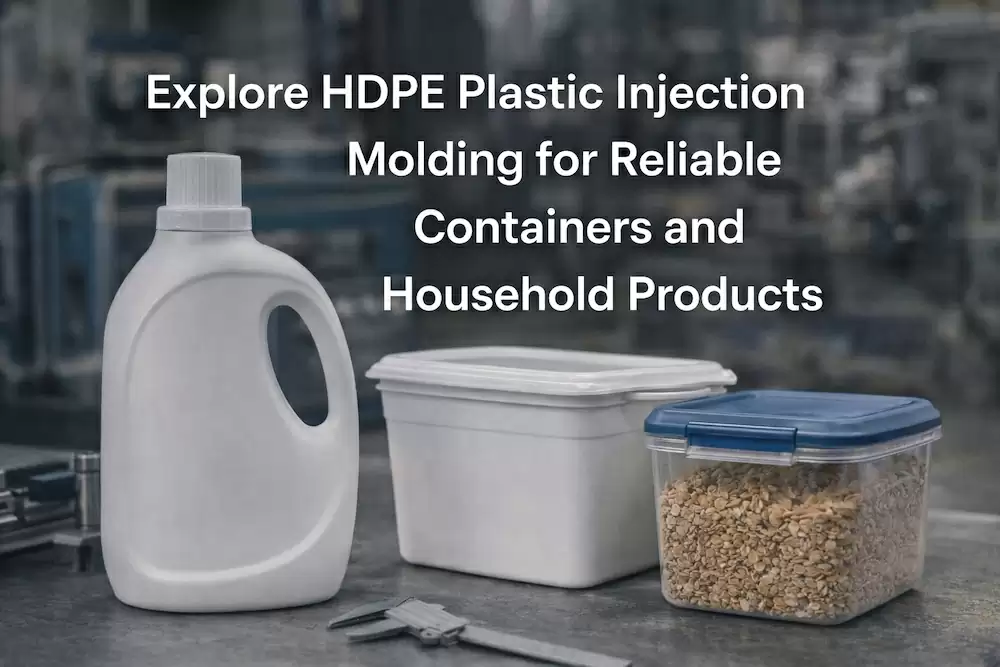
Explore HDPE Plastic Injection Molding for Reliable Containers and Household Products
Chemical resistance • Impact durability • Cost-effective mass production
From detergent bottles and storage bins to food containers and everyday household goods, HDPE plastic injection molding is a proven solution for products that must be tough, safe, and economical. When applied correctly, HDPE delivers consistent performance across millions of cycles—making it a staple material for both consumer and light-industrial applications.
Use this guide—and the TaiwanMoldMaker.com network—to understand where HDPE excels, how to design for it, and how to move from pilot tools to stable, high-volume production.
Explore our end-to-end services:
Custom Mold & Design Maker →
Mold Service →
Injection Mold →
Molding →
Customer Examples →
Contact
Why HDPE is a go-to material for containers and household goods
High-Density Polyethylene (HDPE) is widely used because it combines durability with processing stability and cost control:
-
Excellent chemical resistance
Resists detergents, cleaners, oils, acids, and many household chemicals. -
High impact strength
Performs well in drop tests and rough handling—especially important for containers and storage products. -
Moisture and humidity resistance
Ideal for kitchens, bathrooms, laundry rooms, and outdoor use. -
Food-contact capable grades available
Suitable for food containers, drinkware components, and kitchen accessories. -
Cost-efficient at scale
Stable resin pricing and fast cycle times keep unit costs low in mass production.
Common applications of HDPE injection molding
HDPE injection molding is frequently used for:
-
Household containers – storage boxes, bins, organizers, lids
-
Cleaning and laundry products – detergent caps, dosing cups, holders
-
Kitchenware – food containers, reusable trays, measuring scoops
-
Personal care packaging – jars, closures, cosmetic containers
-
Utility products – buckets, crates, tool holders, protective covers
Its balance of toughness and flexibility makes HDPE especially forgiving in daily consumer use.
Material characteristics that influence design
When designing parts for HDPE injection molding, it is important to account for its natural behavior:
-
Lower stiffness than ABS or PC
HDPE is tough but flexible; ribs and gussets are often required for rigidity. -
Higher shrinkage rate
Typical shrinkage is higher than many engineering plastics, so tooling must be compensated accurately. -
Waxy surface feel
Great for chemical resistance, but limits paint adhesion—texture and color are preferred over coating. -
Good flow for thicker parts
Best suited for moderate wall thicknesses rather than ultra-thin cosmetic housings.
Understanding these traits early prevents warpage, sink marks, and dimensional drift.
Design-for-manufacturing tips for HDPE parts
To get consistent quality from HDPE injection molding, we emphasize:
-
Uniform wall thickness
Target consistent walls (commonly ~1.5–3.0 mm, depending on part size) to avoid sink and uneven cooling. -
Ribs instead of thick sections
Use ribs for stiffness rather than adding mass; this reduces cycle time and improves dimensional stability. -
Generous draft angles
≥1.5–2° draft is recommended due to HDPE’s surface characteristics and flexibility. -
Rounded corners and fillets
Reduce stress concentration and improve flow, especially at rib intersections. -
Gate placement for balanced fill
Gates positioned to avoid hesitation and ensure uniform packing across the part.
All projects begin with a 48-Hour DFM Pack including flow/cool analysis, gate proposals, and a risk log.
Tooling strategies for HDPE injection molding
HDPE is forgiving to mold, but tooling strategy still impacts cost and output:
-
Single-cavity tools
Ideal for pilots, niche SKUs, and early validation. -
Multi-cavity molds
Common for containers and lids where high volumes demand low unit cost. -
Cold runner vs. hot runner
-
Cold runner: simpler, lower tooling cost, acceptable for many HDPE parts
-
Hot runner: reduces scrap and cycle time at high volumes
-
-
Steel selection
HDPE is not abrasive, so tool life is long when standard production steels are used correctly.
We help you choose cavitation and runner systems based on volume forecasts and budget targets.
Process control for stable HDPE production
Although HDPE is relatively easy to mold, process discipline ensures repeatability:
-
Controlled melt and mold temperatures for consistent shrinkage
-
Verified gate-freeze and pack/hold settings to stabilize part weight
-
Scientific molding practices (V/P control, weight ladders) for tighter tolerances
-
MES tracking for OEE, scrap rates, and lot traceability
This approach ensures that early pilot parts behave the same way at full production scale.
Sustainability and recycling considerations
HDPE is one of the most recyclable plastics in consumer markets:
-
Widely accepted in recycling streams
-
Compatible with post-consumer recycled (PCR) content in many applications
-
Suitable for closed-loop reuse in logistics and industrial containers
Where allowed, we can help evaluate PCR blends and validate performance against impact, color, and odor requirements.
Typical timeline for an HDPE injection molding project
A standard container or household product program may follow:
-
Day 0–2: 48-Hour DFM & material confirmation
-
Day 3–10: Tool build (single or multi-cavity)
-
Day 11–13: T0 trial – fill balance, weight ladder, cosmetic check
-
Day 14–15: T1 – FAIR + dimensional review, sample shipment
-
Day 16+: Ramp planning or copy-cavity expansion
Actual timing varies with part size, cavitation, and validation scope.
RFQ checklist for HDPE injection molding
To quickly assess feasibility and cost, include the following in your RFQ:
-
Target annual volume and ramp plan
-
3D CAD (STEP/IGES) + 2D drawings with CTQs
-
Intended use case (food contact, chemical exposure, outdoor use)
-
Preferred HDPE grade or property targets
-
Cosmetic expectations (texture, color, gloss level)
-
Packaging and logistics requirements
-
Budget priorities (tooling cost vs. unit cost)
Send your request here →
Contact
Why choose TaiwanMoldMaker.com for HDPE injection molding
-
Extensive experience with HDPE containers and household products
-
Engineering-led DFM to manage shrinkage and part stiffness
-
Flexible tooling strategies from pilot to high-volume production
-
Data-driven process control for consistent quality and cost efficiency
If you are looking to explore HDPE plastic injection molding for reliable containers and household products, TaiwanMoldMaker.com provides the tooling, molding, and quality oversight to support your program from concept to scale.
Start here:
Injection Mold →
Molding →
Mold Service →
Customer Examples →
Contact
