






How to Source EMI Shielding Parts for High-Speed Optical Transceivers and Connector Assemblies
How to Source EMI Shielding Parts for High-Speed Optical Transceivers and Connector Assemblies
How to Source EMI Shielding Parts for High-Speed Optical Transceivers and Connector Assemblies
As data transmission speeds continue to increase across datacenters, 5G infrastructure, and industrial communication systems, electromagnetic interference (EMI) has become a critical design consideration. For high-speed optical transceivers and connector assemblies, even minor EMI issues can compromise signal integrity, increase error rates, and reduce overall system performance.
This makes sourcing EMI shielding parts not just a procurement task, but a key engineering decision. Buyers must evaluate not only cost, but also precision, material performance, manufacturability, and supplier capabilities.
Why EMI Shielding Is Critical in High-Speed Optical Systems
In high-speed optical environments, signal integrity is everything. While optical signals themselves are immune to electromagnetic interference, the surrounding electronic circuitry—drivers, receivers, and power management components—remains highly sensitive.
Connector assemblies and transceiver modules often integrate multiple elements in compact spaces, including:
- electrical contacts
- shielding structures
- mechanical retention components
- thermal management features
Without effective EMI shielding, these systems can experience signal leakage, crosstalk, or compliance failures. This is why shielding components such as plates, springs, and enclosures must be manufactured with high precision and consistent quality.
Common EMI Shielding Components for Optical Applications
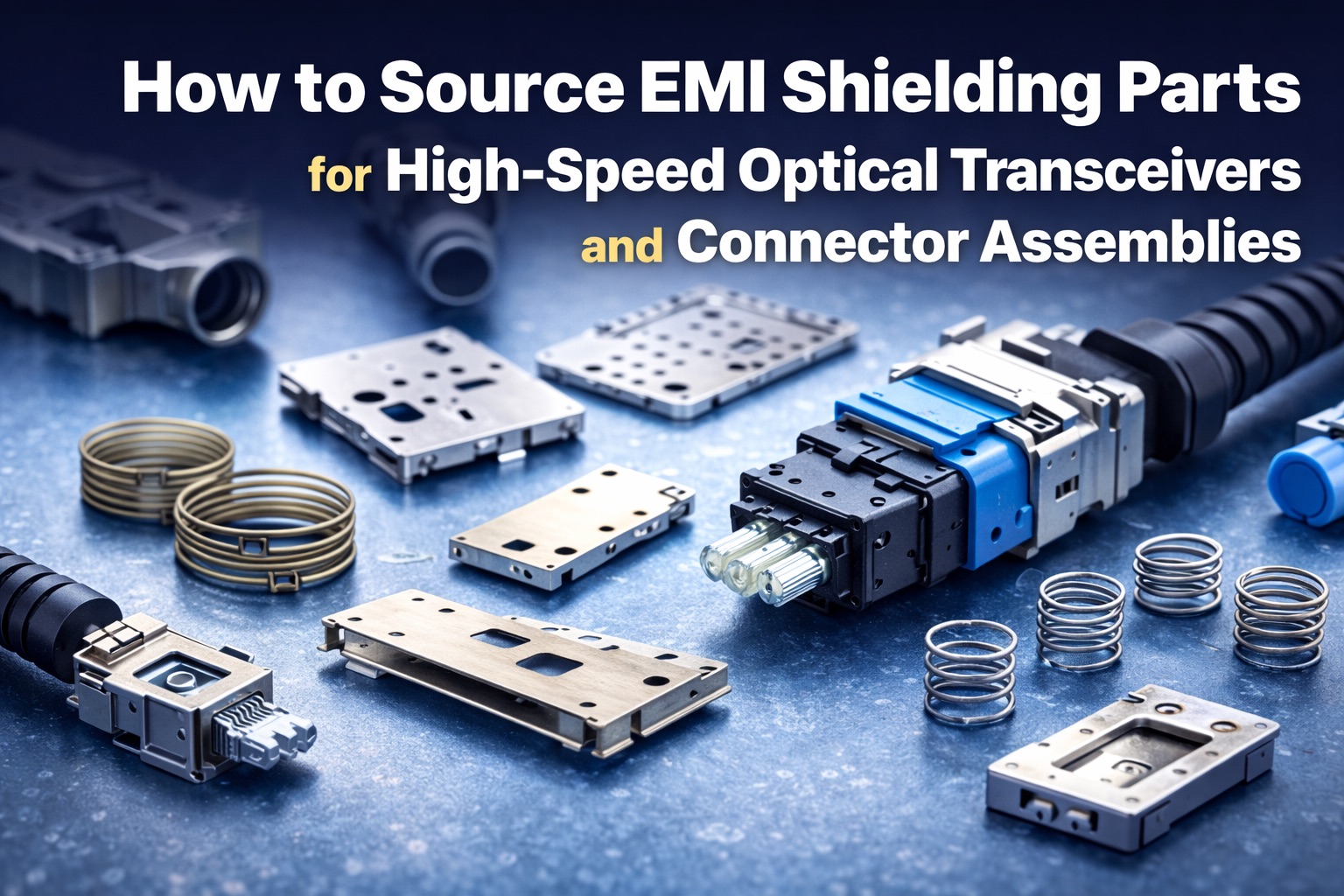
When sourcing EMI shielding parts for optical connector systems, buyers typically require a range of metal components, including:
- EMI shielding plates
- EMI shielding springs
- shielding clips and covers
- ferrule grounding components
- connector housing shielding structures
These parts are usually thin, complex in geometry, and must maintain both mechanical performance and electrical conductivity. As a result, they are best produced using precision metal stamping, which allows for tight tolerances, repeatability, and cost-effective mass production.
Key Factors When Sourcing EMI Shielding Parts
1. Material Selection
Material choice directly affects shielding effectiveness and durability. Common materials include:
- stainless steel
- phosphor bronze
- copper alloys
Each offers different conductivity, spring properties, and corrosion resistance. A qualified supplier offering metal stamping solutions should be able to recommend appropriate materials based on application requirements.
2. Precision and Tolerance Control
EMI shielding parts must fit precisely within connector assemblies. Poor tolerances can lead to gaps, misalignment, or inconsistent grounding.
Working with a supplier that integrates tooling design through custom mold development helps ensure that stamping dies are optimized for repeatability and dimensional accuracy.
3. Tooling and Production Capability
For high-volume optical components, stable tooling is essential. Buyers should look for manufacturers that offer both tooling and production under one roof.
INTERTECH supports this process through its mold service and metal stamping manufacturing, allowing better control over lead time and quality consistency.
4. Integration with Plastic and Silicone Components
EMI shielding parts are rarely used alone. They are typically integrated with:
- plastic housings
- connector bodies
- silicone sealing parts
This is why it is beneficial to work with a supplier that also provides injection mold solutions, plastic molding services, and silicone mold capabilities.
An integrated manufacturing approach reduces compatibility issues and simplifies assembly validation.
Challenges in EMI Shielding Part Manufacturing
Sourcing EMI shielding parts for optical applications presents several challenges:
- ultra-thin material forming without deformation
- maintaining spring elasticity over repeated use
- achieving consistent plating or surface finishing
- controlling burrs and edge quality
A manufacturer experienced in metal stamping services can address these issues through proper die design, progressive stamping techniques, and secondary finishing processes.
Additionally, early-stage collaboration using custom mold and design services can help identify potential manufacturability risks before tooling investment.
Benefits of Working with an Integrated Manufacturing Partner
For optical connector and transceiver manufacturers, managing multiple suppliers for plastic, silicone, and metal parts can increase complexity and lead time.
By choosing a supplier that offers:
buyers can streamline sourcing, improve part compatibility, and accelerate product development cycles.
INTERTECH’s one-stop manufacturing model is particularly suitable for optical component projects that require multiple part types within a single assembly.
What to Ask Your EMI Shielding Supplier
Before finalizing a supplier, buyers should ask:
- Can you support both prototype and mass production?
- What materials and plating options do you offer?
- How do you control dimensional tolerances?
- Do you provide DFM (Design for Manufacturability) feedback?
- Can you integrate with plastic and silicone components?
These questions help ensure the supplier is capable of supporting long-term production, not just initial samples.
Conclusion
Sourcing EMI shielding parts for high-speed optical transceivers and connector assemblies requires more than finding a low-cost supplier. It requires a manufacturing partner that understands precision metal forming, material performance, and integration with other component types.
From EMI shielding plates and springs to connector housing components, every detail contributes to overall system performance. By working with an experienced supplier like INTERTECH—offering metal stamping solutions, molding services, and silicone molding capabilities—buyers can ensure consistency, reliability, and scalability.
If you are sourcing EMI shielding parts for optical applications, you can contact INTERTECH to discuss your project requirements and manufacturing strategy.
