






Solve Complex Injection Molding Challenges with Multi-Gate and Multi-Cavity Solutions
Solve Complex Injection Molding Challenges with Multi-Gate and Multi-Cavity Solutions
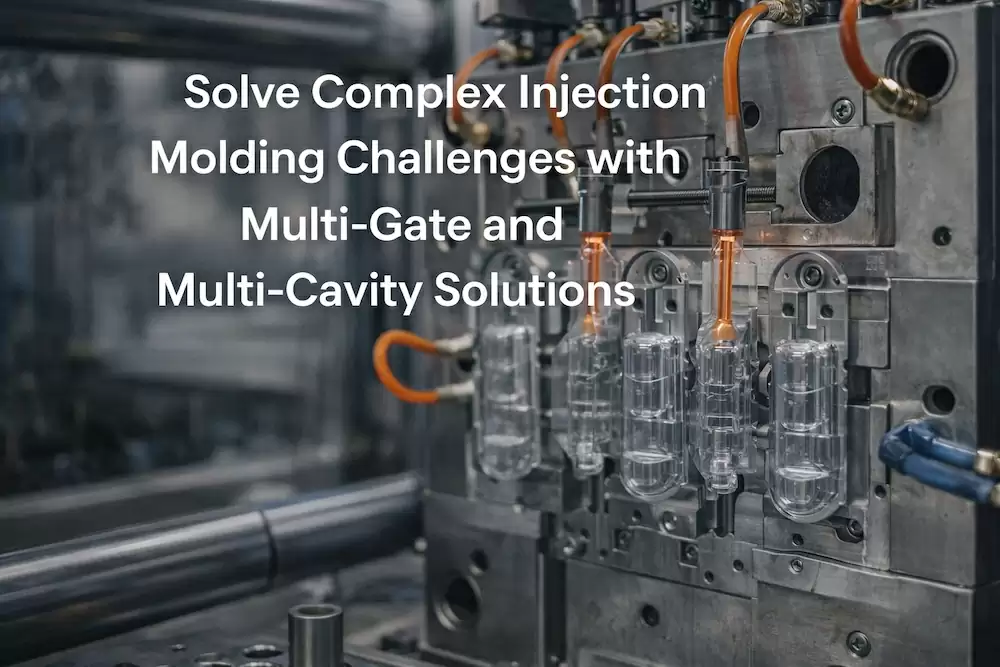
Solve Complex Injection Molding Challenges with Multi-Gate and Multi-Cavity Solutions
Balanced filling • Higher output • Stable quality at scale
As plastic parts become larger, thinner, more cosmetic, or higher volume, single-gate or single-cavity molds often reach their limits. Issues such as short shots, warpage, visible weld lines, and inconsistent part weight are common signals that your program needs a more advanced approach.
By applying multi-gate and multi-cavity injection molding solutions, manufacturers can solve complex molding challenges while improving productivity and unit cost. Through the TaiwanMoldMaker.com network, these solutions are engineered, validated, and industrialized with data-driven discipline.
Explore our end-to-end services:
Custom Mold & Design Maker →
Mold Service →
Injection Mold →
Molding →
Customer Examples →
Contact
When single-gate or single-cavity tools are no longer enough
Complex injection molding challenges often appear when:
-
Parts have large projected areas or long flow lengths
-
Wall thickness is thin and cosmetic requirements are high
-
Output demand exceeds what a single cavity can deliver
-
Tight tolerances require part-to-part consistency
-
Material cost or cycle time must be reduced
In these situations, multi-gate and multi-cavity mold architectures allow engineers to distribute flow, pressure, and production load more effectively.
Multi-gate injection molding: solving flow and cosmetic issues
What multi-gate designs achieve
Multi-gate molding introduces plastic into the cavity from multiple locations, which helps to:
-
Reduce flow length and injection pressure
-
Improve filling of thin-wall or large parts
-
Minimize sink, hesitation, and incomplete fill
-
Control shear and orientation in reinforced materials
This approach is especially valuable for large housings, panels, covers, and structural components.
Engineering considerations
Multi-gate success depends on disciplined engineering:
-
Flow simulation (Moldflow®) to position gates and predict weld-line behavior
-
Valve-gated hot runners to control gate timing and reduce visible knit lines
-
Balanced runner layouts to maintain uniform melt temperature and pressure
-
Gate locations planned away from cosmetic or functional critical zones
With proper simulation and valve control, weld lines can be relocated to low-stress, non-visible areas, or eliminated altogether.
Multi-cavity molds: scaling output without sacrificing quality
Why multi-cavity tools matter
When demand increases, adding cavities is often the most cost-effective way to scale:
-
Higher output per cycle
-
Lower part cost after tooling amortization
-
Consistent quality across high volumes
Multi-cavity solutions are widely used for connectors, medical disposables, caps, closures, and precision components.
The real challenge: cavity balance
The key risk in multi-cavity molding is imbalance—where parts differ in weight, dimensions, or cosmetics. To prevent this, we focus on:
-
Geometrically balanced runner systems
-
Valve-gated hot runners for fine cavity control
-
Cavity-pressure sensors to verify real-time balance
-
Weight-ladder and gate-freeze studies during T0/T1
Each cavity is treated as its own controlled process, not assumed to behave identically.
Combining multi-gate and multi-cavity strategies
For advanced programs, multi-gate and multi-cavity designs are often combined:
-
Large cosmetic housings with multiple cavities
-
Thin-wall industrial parts requiring pressure relief
-
High-volume consumer components with tight tolerances
In these cases, engineering decisions must consider:
-
Clamp tonnage and machine sizing
-
Hot-runner zoning and thermal control
-
Cooling symmetry and cycle-time optimization
-
Scrap risk and startup stability
This is where experience matters—mistakes scale quickly in complex tools.
Scientific molding for complex tools
Multi-gate and multi-cavity molds require data-driven process control:
-
V/P transfer by cavity pressure, not screw position
-
Gate-freeze confirmation for each gate and cavity
-
DOE-defined process windows (Nominal / High / Low)
-
Alarm bands and recipe lockouts in the press
All validated settings are stored as golden recipes, ensuring repeatability across shifts, plants, and regions.
Quality oversight and validation
For complex mold architectures, quality assurance is built in from day one:
-
FAIR + CMM/optical scan by cavity
-
Cosmetic maps identifying gate vestige and weld lines
-
CpK tracking on CTQs across all cavities
-
MES dashboards for OEE, scrap, and cavity-level performance
This level of visibility makes remote audits, PPAP, or medical/industrial validation far easier to manage.
Typical timeline for complex multi-gate / multi-cavity tools
A representative program may follow this structure:
-
Day 0–2: 48-Hour DFM & simulation pack
-
Day 3–14: Tool build (steel), hot-runner integration, cooling verification
-
Day 15–18: T0 – fill balance, weight ladder, gate-freeze studies
-
Day 19–23: Adjustments (gate timing, venting, polish)
-
Day 24–26: T1 – full FAIR + CMM/scan, cosmetic sign-off
-
Day 27+: Ramp planning, copy-cavity or second-tool strategy if required
Actual timing depends on part size, resin, cavitation, and validation scope.
RFQ checklist for multi-gate and multi-cavity projects
To efficiently evaluate complex molding solutions, include the following in your RFQ:
-
Target annual volume and peak demand
-
3D CAD (STEP/IGES) + 2D drawings with CTQs and GD&T
-
Cosmetic requirements and no-weld / no-gate zones
-
Preferred materials and alternates
-
Validation requirements (CpK targets, PPAP, IQ/OQ/PQ)
-
Planned regions of production (single site or multi-plant)
-
Any future scale-up expectations (copy-cavity, family tools)
Send your package here →
Contact
Why choose TaiwanMoldMaker.com for complex injection molding
-
Deep experience with multi-gate and multi-cavity tooling
-
Simulation-led design and scientific molding execution
-
Valve-gated hot-runner and sensor-enabled processes
-
MES visibility for cavity-level quality and performance
-
Clear scale-up path from pilot to global production
By combining advanced mold architecture with disciplined engineering and quality oversight, TaiwanMoldMaker.com helps you solve complex injection molding challenges—and turn them into competitive advantages.
Start here:
Injection Mold →
Molding →
Mold Service →
Customer Examples →
Contact
