






Experiment with ABS Plastic Molding at Home for Small DIY Projects
Experiment with ABS Plastic Molding at Home for Small DIY Projects
Experiment with ABS Plastic Molding at Home for Small DIY Projects
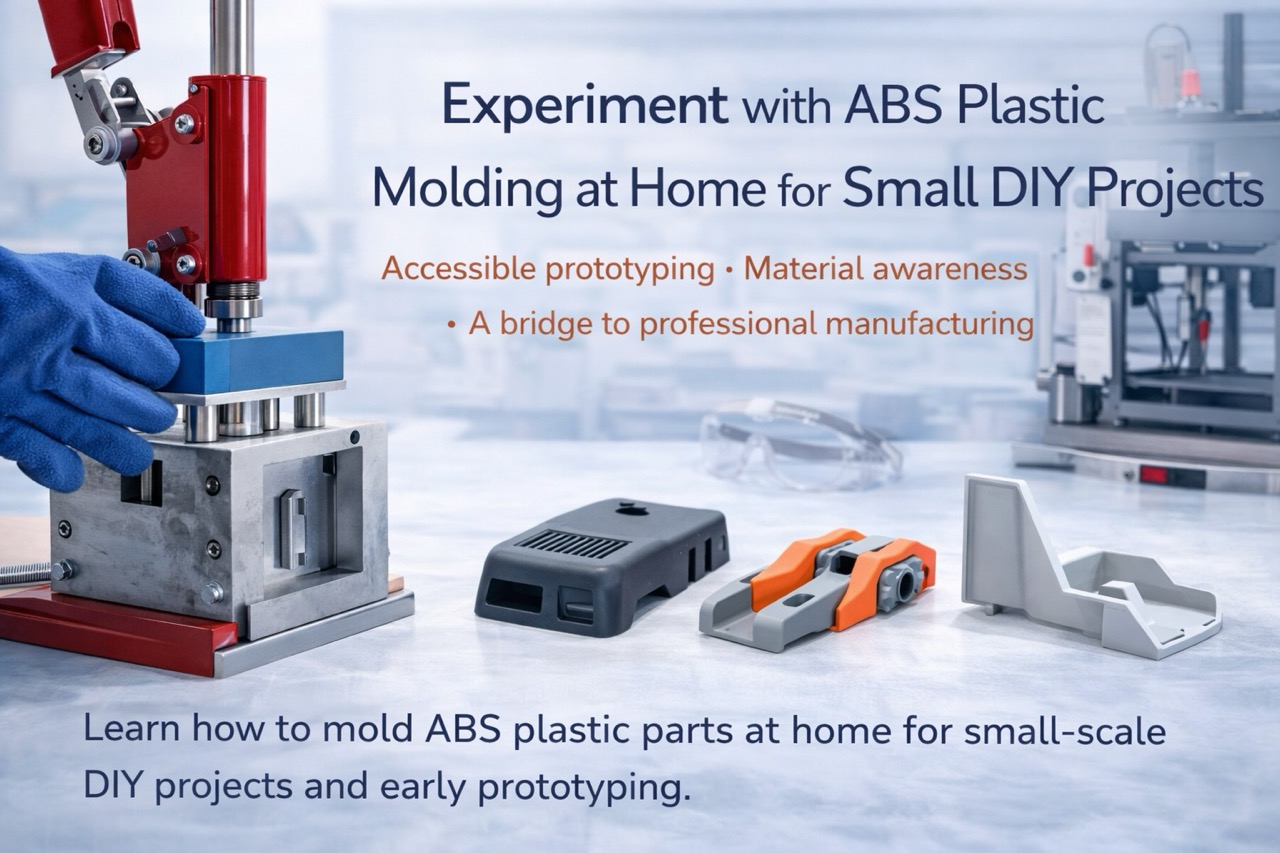
Accessible prototyping • Material awareness • A bridge to professional manufacturing
ABS (Acrylonitrile Butadiene Styrene) is one of the most familiar plastics in product development, widely used for enclosures, tools, and consumer goods. Because of its availability and forgiving processing window, many makers and engineers choose to experiment with ABS plastic molding at home for small DIY projects, proof-of-concept parts, and early design validation.
This article explains what is realistically achievable with home-based ABS molding, the limitations you should be aware of, and how to transition successfully from DIY experiments to professional injection molding with TaiwanMoldMaker.com.
Why ABS is popular for DIY plastic molding
ABS is often the first engineering plastic people experiment with because it offers:
-
Good impact resistance and toughness
-
Easy machining and post-processing
-
Compatibility with multiple forming methods
-
Wide availability in pellets, sheets, and filaments
-
Relatively low material cost
These properties make ABS suitable for learning material behavior before committing to production tooling.
Common home methods for ABS molding and forming
While true industrial injection molding cannot be replicated at home, several small-scale techniques allow meaningful experimentation.
1. Heat forming and compression molding
Using controlled heat (oven, heat gun, or hot plate), ABS sheets or pellets can be softened and pressed into simple molds.
Best for:
-
Flat or shallow parts
-
Enclosures, covers, or brackets
-
Learning wall thickness and cooling behavior
Limitations:
-
Low dimensional accuracy
-
Inconsistent surface finish
-
Limited repeatability
2. DIY hand-injection or benchtop presses
Some makers use manual or benchtop injection tools to inject molten ABS into small aluminum molds.
Best for:
-
Very small parts
-
Single-cavity experiments
-
Understanding gate location and flow behavior
Limitations:
-
Low pressure compared to industrial machines
-
Limited part geometry and detail
-
Inconsistent packing and strength
3. Molded prototypes combined with machining
A common DIY approach is to:
-
Rough-form ABS parts with heat or hand injection
-
Finish critical features via CNC or manual machining
This hybrid method is effective for functional prototypes where cosmetics are not critical.
What DIY ABS molding is good for—and what it is not
Good use cases
Home ABS molding works well for:
-
Design exploration and early iteration
-
Fit and assembly checks
-
Understanding shrinkage and warpage trends
-
Demonstrating a concept to stakeholders
These experiments reduce risk before engaging Custom Mold & Design Maker services.
Not suitable for
DIY ABS molding is not suitable for:
-
Tight tolerances
-
Cosmetic consumer-facing parts
-
Structural or safety-critical components
-
Consistent batch production
For these requirements, professional tooling and process control are essential.
Safety considerations when molding ABS at home
ABS must be handled responsibly:
-
Avoid overheating—ABS can release unpleasant fumes
-
Ensure proper ventilation
-
Use temperature-controlled equipment
-
Wear protective gloves and eye protection
Home experiments should always prioritize safety over speed or appearance.
Key limitations compared to professional injection molding
Home ABS molding lacks:
-
Precise temperature, pressure, and speed control
-
Uniform packing and cooling
-
Hardened steel tooling
-
Process repeatability and documentation
These gaps explain why DIY methods are best viewed as learning tools, not production solutions.
How to transition from DIY ABS molding to production
Once your concept is validated, the next step is to industrialize the design.
At TaiwanMoldMaker.com, we typically help customers transition by:
-
Reviewing DIY learnings during structured DFM
-
Optimizing wall thickness, draft, and ribs
-
Selecting appropriate ABS grades (impact, flame-retardant, etc.)
-
Defining tooling strategy (soft tooling vs. production steel)
This process is handled through Mold Service and Injection Mold workflows.
Why professional ABS injection molding delivers better ROI
Compared with DIY methods, professional injection molding provides:
-
High repeatability and tight tolerance control
-
Superior surface finish and cosmetic quality
-
Faster cycle times at scale
-
Lower unit cost for medium-to-high volumes
-
Long-term tool life and predictable output
Production molding and ramp-up are managed through Molding with clear quality and delivery benchmarks.
RFQ checklist after DIY validation
If you have already experimented with ABS at home, prepare the following to move forward:
-
Updated 3D CAD (STEP/IGES) reflecting lessons learned
-
Target annual volume and launch timeline
-
Performance requirements (impact, heat, flame rating)
-
Cosmetic expectations
-
Budget priorities (prototype vs. production tooling)
You can submit your project here:
Contact
Why TaiwanMoldMaker.com is the right next step
-
Engineering-led transition from DIY concepts to production-ready designs
-
Proven ABS injection molding expertise across industries
-
Flexible tooling strategies aligned with real demand
-
Transparent cost, schedule, and quality control
-
Real-world results shown in Customer Examples
If you are experimenting with ABS plastic molding at home for small DIY projects, TaiwanMoldMaker.com helps you convert those experiments into reliable, scalable injection-molded products—without unnecessary trial and error.
Start here:
Custom Mold & Design Maker →
Mold Service →
Injection Mold →
Molding →
Contact
